Buying guide
How to Choose the Right Grinding Machine: A Buyer’s Checklist
Choose a grinding machine by starting from the component: which surfaces must be ground (OD, ID, face, profile), the size range, tolerance and finish, and monthly volume. Those decide the machine type and CNC vs hydraulic; then compare structure (cast-iron bed, guideways, spindle), automation, service support and total cost of ownership.
A grinding machine is a 15- to 25-year investment. Buying the wrong type, or the right type in the wrong size, costs far more than the price difference between models. Work through these questions before you request quotations.
1. Which surfaces must be ground?
- Outside diameters and shoulders → external cylindrical grinder (straight or angular head) — or centerless for plain, high-volume parts.
- Bores → internal grinder; long bores → internal long-bore grinder with steady rest.
- Bore + OD that must be concentric → hybrid ID/OD grinder (single chucking).
- Bearing raceways or profiles → track grinder with profile dresser.
- Lips, faces, flats → lip/face or surface grinder.
2. What is the size envelope?
List the minimum and maximum diameter, length, and weight of the parts you will grind — today and in the next five years. For between-centre work, choose the admit-between-centres length with some margin; for chucked work, check swing and weight including the chuck.
3. Tolerance, roundness and finish
Write down the tightest diameter tolerance, roundness/cylindricity and Ra finish on your drawing. These drive spindle type (hydrodynamic, cartridge on angular-contact bearings), guideway type and whether you need in-process gauging.
4. Batch size and monthly volume
Small batches of varied parts favour flexible hydraulic machines. Repeat volumes of the same part favour CNC — and very high volumes justify auto-loading.
5. CNC or hydraulic?
| Hydraulic | CNC | |
|---|---|---|
| Best for | Tool room, job shop, small batches | Repeat production, complex parts |
| Operator skill | Higher | Lower per part |
| Investment | Lower | Higher |
| Middle path | Hydraulic machine with single-axis CNC in-feed (e.g. KIYA HCG, CL) | |
6. Check the construction
- One-piece, close-grained cast-iron bed with box structure and ribbing — and is it stress-relieved?
- Guideways: hand-scraped V-flat, Turcite, or precision cross-roller?
- Wheel spindle: hydrodynamic or cartridge type; spindle material and bearings.
- Axis calibration: laser-calibrated? Glass-scale feedback where it matters?
7. Automation and gauging
Ask whether loaders, in-process gauges and post-process measurement can be integrated now or later.
8. Service, spares and training
Downtime on a finishing machine stops your whole line. Prefer a manufacturer with in-house service engineers, spares stock and operator training — ideally in your time zone and language.
9. Proof
Ask for references in your industry and, if possible, a trial grind on your own part.
10. Total cost of ownership
Compare price plus wheels, coolant filtration, power (IE2/IE3 motors), maintenance and expected life — not price alone.
Next step
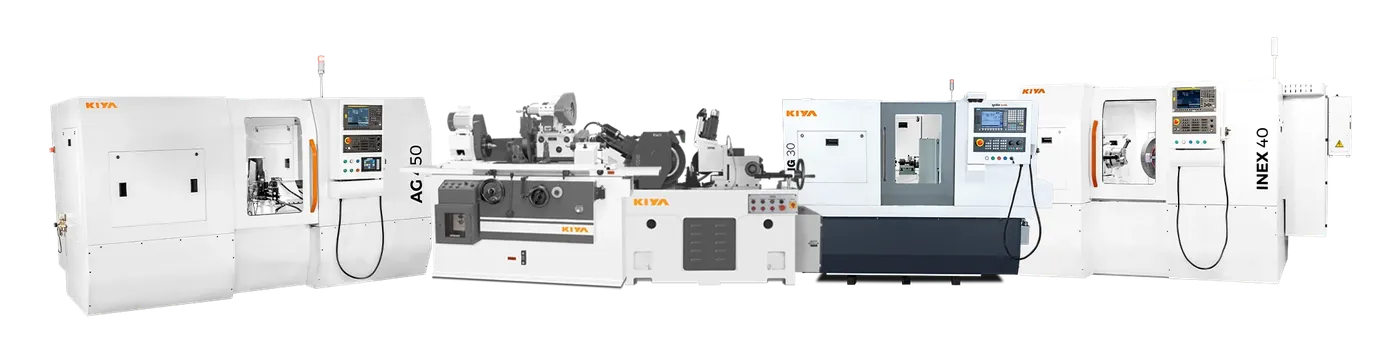
Send your drawing, material, stock allowance and monthly quantity to KIYA. Our application engineers will answer these ten questions with you and recommend the right model from our eight grinder series.
Frequently asked questions
What information do I need to get a grinding machine quotation?
Component drawing (or main dimensions), material and hardness, grinding stock allowance, required tolerance and finish, and expected monthly quantity.